
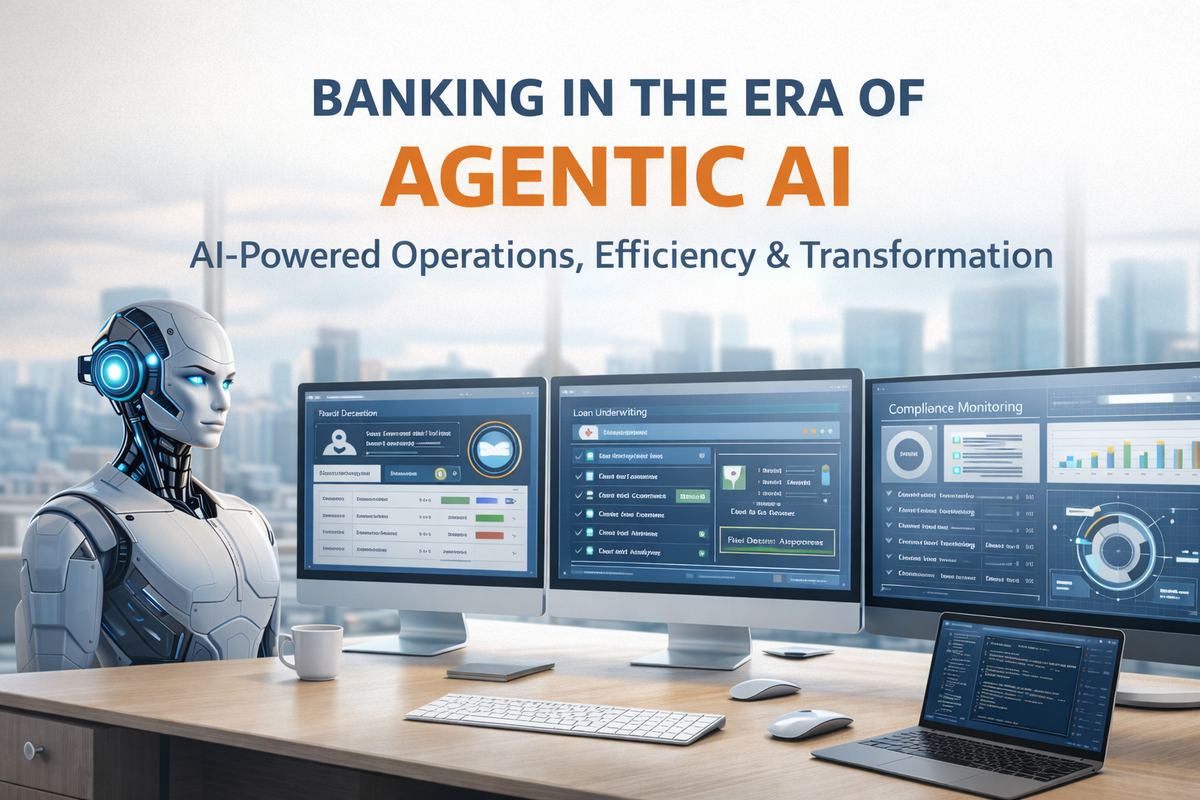
It's Monday Morning, 2028
Sara is a compliance analyst at a mid-sized regional bank. She walks in at 8:45 AM, coffee in hand. Her AI agent has already reviewed 11,400 overnight transactions, flagged 23 as suspicious, filed 4 preliminary SARs (Suspicious Activity Reports), and drafted an executive summary — complete with risk scores, customer history, and recommended next steps. What used to take her team of six an entire week now takes 47 minutes.
Meanwhile, across the lobby, a customer named David applies for a home loan through the bank's mobile app. An underwriting agent pulls his credit history, verifies employment through payroll APIs, cross-references property records, runs a debt-to-income analysis, and delivers a conditional approval — all before David finishes his morning commute. The human loan officer reviews the file in three minutes. Approved.
This isn't science fiction. Every piece of this scenario is either live in production at a major bank today or in active pilot. The agentic AI revolution in banking isn't coming — it's already here, and it's rewriting the economics of every department from the trading floor to the back office.
$67 Billion and Counting
Financial services firms are expected to spend more than $67 billion on AI by 2028, according to McKinsey's 2025 Global Banking Review. The AI agents market in financial services alone is projected to grow from $1.79 billion in 2025 to $6.54 billion by 2035, a 13.84% CAGR — and that's the conservative estimate from Precedence Research.
The adoption numbers are even more striking. According to Banking Dive, 44% of finance teams will use agentic AI in 2026 — a 600% increase from the prior year. Up to 98% of North American banks are using AI in at least one operational process, and 92% have deployed AI chatbots and conversational agents. Over 70% of Tier-1 banks plan to increase AI budgets specifically for fraud detection and AML modernization.
This isn't just the megabanks. Deloitte reports that 82% of midsize companies and 95% of PE firms have begun or plan to implement agentic AI in 2026. The question across the industry has shifted from "should we invest?" to "how fast can we deploy?"
Real Banks, Real Results
JPMorgan Chase has gone furthest. With an $18 billion annual technology budget and 450+ AI use cases in production, JPMorgan now has 200,000 employees using its proprietary LLM Suite daily. Results include $220 million in benefit from AI-driven credit card upgrades and $100 million from AI-powered commercial banking suggestions. The bank targets $1.5 billion in total AI-driven value. An internal demo showed AI creating an investment banking deck in 30 seconds.
Bank of America's Erica has quietly become the most successful AI agent in consumer banking. With over 3 billion client interactions, nearly 50 million users, and 58 million interactions per month, Erica delivers answers in an average of 48 seconds with a 98% success rate. Internally, over 90% of employees use Erica for Employees — reducing IT service desk calls by more than 50%.
Goldman Sachs announced in February 2026 a partnership with Anthropic for autonomous agent development, with embedded Anthropic engineers working for six months on trade accounting automation and client onboarding. Morgan Stanley reports 98% of its advisor teams actively use its OpenAI-powered assistant, with document retrieval efficiency jumping from 20% to 80%. HSBC runs 600+ AI use cases and analyzes over 1 billion transactions monthly through its Dynamic Risk Assessment platform, detecting 2-4x more suspicious activity while reducing false positives by 60%.
Five Use Cases Reshaping Every Department
Fraud detection is where agents have had the most dramatic impact. By late 2025, 92% of fraudulent activities were intercepted before approval at banks with agentic AI systems. These aren't rule-based filters — they're autonomous agents evaluating context, weighing behavioral patterns, and making instant decisions. HSBC's system runs across 100% of credit card transactions in the US, Europe, and Asia simultaneously.
KYC and AML compliance is being transformed from a cost center into an automated workflow. McKinsey reports that agents can autonomously handle document verification, biometric checks, AML screenings, and compliance reporting — with a full audit trail. BCG estimates KYC costs can drop 50-70% through automation. Given that AML currently consumes 5% of total banking costs, the savings are enormous.
Wealth management is splitting into two tiers. Global robo-advisor assets have crossed $1 trillion, with projections of $5.9 trillion by 2027. Advanced platforms now handle tax-loss harvesting in microseconds and rebalance across 11,000 global assets. But the real shift is AI-enhanced human advisory — Morgan Stanley's AI copilot gives advisors instant access to research, market trends, and client context, collapsing preparation time from hours to seconds.
Back-office operations — reconciliation, settlements, accounts payable — are moving toward full autonomy. Agents match transactions instantly, flag discrepancies, trigger settlements when liquidity thresholds are met, and manage the entire payment lifecycle. The Federal Reserve Bank of Atlanta notes that agentic payments now incorporate "advanced reasoning, long-term planning, and multi-agent collaboration."
A Fictional Thursday in 2030
Priya hasn't visited a bank branch in three years. Her personal finance agent — she calls it "Fin" — monitors her spending, optimizes her tax position in real time, and last month negotiated a 0.3% rate improvement on her mortgage by comparing offers across 14 lenders in 90 seconds. When her car needed a $4,200 repair, Fin pulled funds from three accounts in the optimal tax sequence, factored in her upcoming bonus, and adjusted her retirement contribution by $80/month for six months to compensate — all before sending her a two-sentence summary.
Her bank still exists. But it looks nothing like it did in 2024. The branch has three employees instead of twenty. The loan department is four people overseeing an AI system that processes 12,000 applications daily. The compliance team — once 45 analysts — is now 8 specialists reviewing the 2% of cases that agents escalate. The bank is more profitable than ever. It just doesn't need humans for the parts that humans were never good at anyway — processing speed, pattern recognition across millions of data points, 24/7 monitoring without fatigue.
The Risks That Keep Regulators Awake
The speed of adoption has outpaced every regulatory framework on the planet. The EU AI Act classifies credit scoring and creditworthiness evaluation as high-risk AI — requiring structured risk management, quality controls, and human oversight — with compliance deadlines hitting August 2026. In the US, there's no comprehensive federal AI framework yet, just a patchwork of agency guidance from the OCC, Fed, and CFPB.
AI hallucinations in financial advice carry catastrophic risk. Incorrect interest rate disclosures, miscalculated risk assessments, and false compliance information don't just damage trust — they trigger regulatory action. Major banks including JPMorgan, Wells Fargo, and Goldman Sachs have banned ChatGPT-style tools internally and built proprietary systems with hallucination dashboards and forced citation of verified sources.
Then there's systemic risk. The Financial Stability Board warns that similar AI models reacting to the same market signals could amplify volatility — coordinated selling triggered not by human panic but by algorithmic consensus. An NBER working paper demonstrated that AI trading agents can sustain collusive profits autonomously without any explicit agreement. The regulatory infrastructure for this doesn't exist yet.
200,000 Jobs — And What Replaces Them
The workforce question is the one nobody wants to answer honestly. Industry estimates project up to 200,000 banking jobs displaced over the next 3-5 years, concentrated in back-office and middle-office operations. McKinsey projects 40-50% productivity gains in operations roles as AI agents become routine.
But the current reality is more nuanced. JPMorgan's headcount grew by 2,000 in 2025. Goldman Sachs has 1,800 more employees than the previous year. Banks are pulling back on hiring — not slashing. The displacement is happening through attrition, role restructuring, and the quiet absorption of tasks that used to require new hires.
What Happens Between Now and 2030
2026 is the year of production-scale deployment. Deloitte forecasts that over 57% of banking executives expect AI agents fully embedded in risk, compliance, and audit functions this year. Customer-facing agents handle real requests autonomously. FinTech Times calls 2026 "the death of information asymmetry" — the moment when customers, armed with their own AI agents, can negotiate as effectively as the institutions they deal with.
2027-2028 brings autonomous banking at scale. Open banking matures into embedded finance ecosystems. AI agents act as bridges connecting bank products, insurance, investment, and tax optimization into seamless, personalized financial management — what Sara's 2028 morning looked like in our opening.
2029-2030 reshapes the competitive landscape entirely. McKinsey projects that AI benefits will eventually accrue to customers, not banks — shrinking global profit pools as competition intensifies and customer switching costs collapse. The banks that survive aren't the biggest. They're the ones with the best orchestration, governance, and trust.
If your organization is still debating whether to start an AI pilot, the debate is already over. The pilot banks are in production. The production banks are scaling. And the customers — increasingly advised by their own AI agents — are about to start choosing accordingly.
References
- McKinsey — Global Banking Annual Review 2025
- Precedence Research — AI Agents in Financial Services Market 2025-2035
- Deloitte — Agentic AI in Banking
- CNBC — JPMorgan's Blueprint for an AI Megabank
- Bank of America — Erica Surpasses 3 Billion Interactions
- CNBC — Goldman Sachs Partners with Anthropic for AI Agents
- McKinsey — How Agentic AI Can Change the Way Banks Fight Financial Crime
- BCG — Know Your Customer: The Agentic AI Revolution
- Financial Stability Board — Monitoring AI Adoption in Finance
- NBER — AI Trading and Algorithmic Collusion
- European Banking Authority — AI Act Implications for Banking
- Federal Reserve Bank of Atlanta — Agentic AI in Payments
- Irish Times — 200,000 Banking Jobs at Risk from AI
- HSBC — Transforming HSBC with AI
- FinTech Times — Banking Trends 2026


Member discussion: