
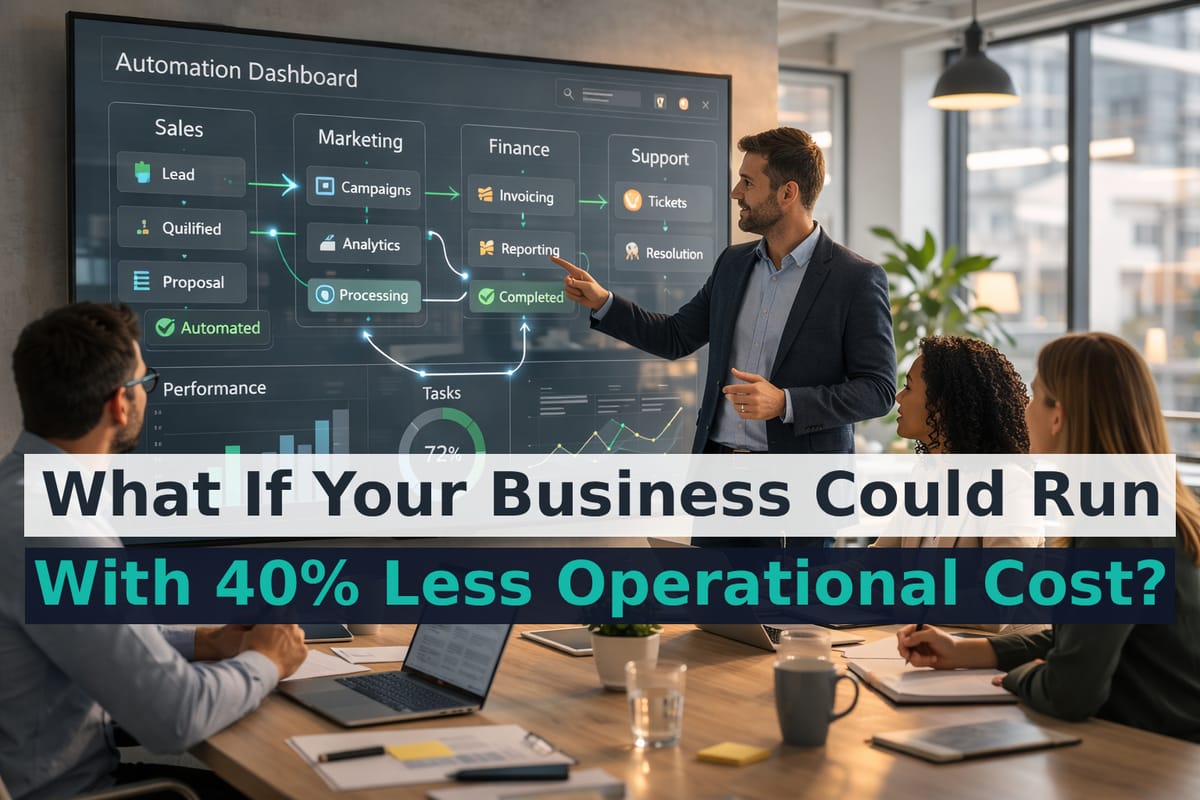
What Is AI Automation for Businesses — and How Can It Actually Cut Your Costs?
93% of business leaders plan to invest in AI within the next 18 months — and the primary driver isn't hype. It's cost reduction. Companies running AI automation at scale report 20–30% lower operational costs and 40%+ efficiency gains, per McKinsey. But 95% of generative AI pilots never make it past experimental. So what separates the companies saving millions from the ones burning budget on demos?
AI Automation: Beyond the Buzzword
AI automation uses artificial intelligence to perform tasks that traditionally required human judgment. It sits on a spectrum: simple rule-based bots (RPA) that follow scripts, AI systems that learn and adapt to unstructured data, and fully autonomous agentic AI that plans, executes, and adjusts multi-step workflows without human intervention.
The difference from traditional automation is adaptability. An RPA bot copies field A to field B. An AI agent reads an unstructured email, extracts intent, cross-references your ERP, and routes it — handling exceptions that would break a rules engine.
The market reflects this shift. The agentic AI market sits at $7.55 billion in 2025, projected to hit $199 billion by 2034 (43.8% CAGR). Gartner expects 40% of enterprise apps to include AI agents by end of 2026.
Where Cost Savings Actually Come From
Customer service is where most companies start. AI agents handle 60–80% of L1 queries — rebookings, billing, tracking — while humans focus on complex cases. One air carrier in Deloitte's 2026 report cut costs by deploying AI for exactly these high-volume, low-complexity tasks.
Finance and compliance offer the highest per-transaction savings — up to 40% cost reductions through automated reconciliation, fraud detection, and regulatory reporting. Banks collectively could save $447 billion through AI-driven optimization.
Supply chain delivers ~30% cost reduction via demand forecasting, inventory optimization, and route planning. AI-powered demand forecasting alone can cut inventory carrying costs by 20–50% vs. spreadsheet-based planning.
Back-office operations (AP, procurement, compliance) show the fastest ROI: 40% FTE cost reduction, 80% fewer errors, 50% faster cycle times — typically within 3–6 months.
The Reality Check
If the ROI is this clear, why isn't everyone doing it? Because the gap between "adopted AI" and "realized value" is enormous.
Redwood's Enterprise Automation Index found 73% of companies increased automation spending, but 61% admit their tools are underutilized due to fragmented strategies. Only 1% of enterprises feel they've achieved true AI maturity. And while companies report function-level wins, over 80% see no meaningful impact on enterprise-wide EBIT.
Five Strategies That Actually Work
1. Redesign the process first. The biggest predictor of success isn't the model — it's whether you redesign the workflow before deploying AI. JPMorgan didn't just hand developers a coding assistant; they restructured development workflows so AI handled routine tasks while engineers focused on higher-value work.
2. Fix your data. Organizations with well-governed data achieve ROI 40–60% faster. If your records are scattered across 12 systems with no unified schema, no AI agent will deliver clean automation.
3. Start with back-office. High-volume, low-variability processes (AP, compliance, procurement) deliver measurable ROI in 3–6 months. Don't start with your most complex customer-facing process.
4. Budget above 5% of IT spend. Organizations above this threshold see 70–75% of AI projects yield positive results, vs. 50–55% for minimal spenders.
5. Build conservative business cases. Use 40% FTE reduction (not 80%), 50% faster cycles (not 90%), and 6-month payback. If the math works on conservative numbers, you have a real investment. If it only works on vendor projections, you have a PowerPoint.
The Bottom Line
PwC predicts 15% of daily business decisions could become fully autonomous by 2028. AI spending is projected to reach $1.3 trillion by 2029. And IBM's research shows companies realize $3.50 for every $1 invested in AI — for those who get implementation right.
AI automation isn't a technology decision — it's an operating model decision. The companies cutting costs by 20–30% aren't buying better AI. They're redesigning how work gets done. Start where ROI is measurable, fix data governance first, budget seriously, build honest business cases, and be deeply skeptical of any vendor whose "agentic AI" can't handle exceptions on its own.
References
- AI Cost Reduction Through Business Process Automation — ARDEM
- Enterprise Automation Index 2025 — Redwood Software
- State of AI in the Enterprise 2026 — Deloitte
- Agentic AI Market — Precedence Research
- 2026 AI Business Predictions — PwC
- Enterprise AI Agents 2026 — OneReach.ai
- The State of AI — McKinsey
- AI Automation Real Use Cases 2026 — MAIA

Member discussion: