
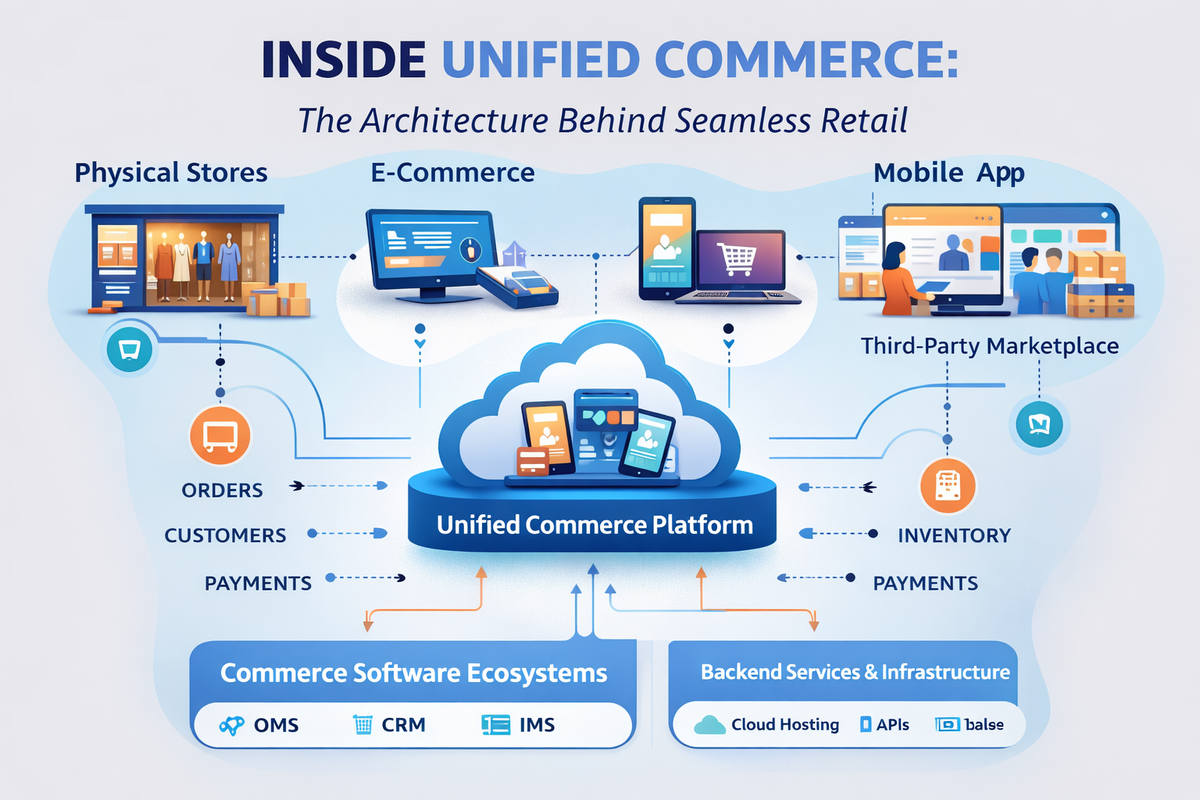
What if every sales channel your business runs — the website, the mobile app, the physical store, the marketplace listing — shared a single heartbeat? One inventory count. One customer profile. One order history. No sync delays, no conflicting data, no "sorry, the website says we have it but we actually don't."
That's the promise of Unified Commerce, and in 2026, it's no longer aspirational architecture — it's table stakes. The global unified retail commerce platform market hit $1.52 trillion in 2025 and is projected to reach $8.5 trillion by 2034 at a 21% CAGR. Brands running mature unified commerce systems report 23% higher inventory turnover, 1.5x greater customer lifetime value, and up to 150% growth in omnichannel gross merchandise volume.
But "unified" doesn't happen by accident. It requires a deliberate architecture — a set of interlocking components designed to keep every channel in lockstep, in real time. In this post, we'll pull back the curtain on what a Unified Commerce Platform (UCP) actually looks like under the hood: the core building blocks, the architectural patterns that make it work, who's doing it well, and the hard tradeoffs you'll face along the way.
Why Unified Commerce Is the New Baseline
To understand why UCP matters, it helps to see where retail architecture has been. The journey went roughly like this: siloed systems (each channel running its own stack independently), to multichannel (multiple channels, still disconnected backends), to omnichannel (integrated customer experience but separate systems stitched together with middleware), to unified commerce — a single platform with one source of truth. The critical distinction between omnichannel and unified is architectural, not cosmetic.
Omnichannel relies on multiple backend systems that talk to each other but are rarely in perfect sync. A customer checks stock online, drives to the store, and the item isn't there. Unified commerce eliminates that gap entirely — all data across all channels updates in real time from a shared backend.
The business case is now proven. Shopify reports that brands on their unified platform see 36% higher checkout conversion and 22% lower total cost of ownership. Event-driven inventory systems have slashed data propagation times from 4.2 hours down to 2.3 seconds, dropping "purchased but out of stock" incidents from 8.6% to just 0.4%. Meanwhile, 99% of retailers now acknowledge that unified commerce directly impacts profitability — yet only 42% consider their stores ready for it. That gap is where the opportunity lives.
The timing is also driven by customer expectation. Mobile commerce accounts for 59% of online retail sales in 2025, B2B ecommerce is approaching $36 trillion by 2026, and AI-powered personalization is shifting from experiment to expectation. Customers don't think in channels. Your architecture shouldn't either.
Anatomy of a Unified Commerce Platform
Think of a UCP like a nervous system. There's a brain (the central data layer), a spine (the API gateway), and specialized organs (individual services) — each doing one job extremely well, but all sharing the same bloodstream of real-time data. Here are the core components:
Order Management System (OMS). The command center. Every order from every channel — website, app, marketplace, in-store POS — flows through one system. The OMS orchestrates fulfillment across locations, manages returns, and provides real-time order status. It's the single repository that gives you complete supply-chain visibility.
Product Information Management (PIM). Your product catalog's single source of truth. Descriptions, pricing, images, availability, channel-specific attributes — all managed centrally and pushed to every touchpoint. When the PIM updates a price, it's live everywhere instantly. The OMS and PIM integration is critical: accurate product data enables accurate order processing, and inventory levels flow back to keep availability current.
Customer Data Platform (CDP). This is where identity resolution happens. A CDP aggregates data from websites, mobile apps, POS systems, email, and support tools into unified customer profiles. When someone browses on their phone, buys on their laptop, and returns in-store, the CDP knows it's the same person. The CDP market is growing from $9.7 billion to $37.1 billion by 2030 — a sign of how central unified customer data has become.
Real-Time Inventory Engine. This is the component that makes "buy online, pick up in store" actually work. Using event-driven architecture, inventory changes propagate across all channels in seconds. Every sale, return, restock, and transfer triggers an event that every subscribing service receives immediately. The results are dramatic: retailers using event-driven inventory see 43% less system load and near-zero overselling.
Payment Orchestration Layer. A smart routing layer between your platform and multiple payment service providers, acquirers, and banks. It picks the optimal route for each transaction, handles failover if a provider goes down, manages 3DS and PCI compliance, and runs fraud detection — all invisibly. This market is projected to grow from $3.1 billion in 2026 to $30.1 billion by 2035.
API Gateway. The front door. Every client request — from your web frontend, mobile app, kiosk, or partner integration — enters through a single gateway that handles routing, authentication, rate limiting, and response aggregation. It's what makes headless commerce possible: any frontend can consume the same backend services.
Event Bus / Message Queue. The connective tissue. Services communicate through an asynchronous publish-subscribe system (commonly Apache Kafka or RabbitMQ). When an order is placed, the event flows to inventory, fulfillment, CRM, analytics, and notification services — all independently, all in parallel. This loose coupling is what allows each component to scale and deploy independently.
Who's Getting It Right
Shopify has become the poster child for unified commerce at scale. Their platform natively connects every sales channel, inventory pool, and customer record in real time, with headless storefronts via their Hydrogen framework running on edge infrastructure. The numbers speak for themselves: brands report replatforming in just 3-5 months and seeing up to 150% omnichannel GMV growth.
Commercetools pioneered the MACH approach (Microservices, API-first, Cloud-native, Headless) — and the market has followed. With 79% of IT leaders now interested in adopting more MACH principles, Commercetools' component-based, vendor-agnostic architecture lets enterprises swap individual services without replacing the entire stack. Their B2B MACHcellerator program has accelerated enterprise deployments significantly.
Google's Universal Commerce Protocol (UCP), launched in January 2026, represents the next frontier. It's an open-source standard designed for agentic commerce — where AI agents can navigate commerce APIs directly to find, compare, and purchase products on a user's behalf. Backed by Shopify, Walmart, Target, Visa, Mastercard, and Stripe, it decouples payment instruments from payment handlers and creates a common language that AI agents can speak across any merchant. This is unified commerce meeting artificial intelligence at the protocol level.
The Hard Tradeoffs You'll Face
Unified commerce architecture isn't without friction. Legacy integration remains the biggest headache — 55% of retailers report inadequate tools for unified commerce execution, and migrating from monolithic systems with proprietary APIs requires careful, phased approaches rather than rip-and-replace. Data quality in legacy systems often prevents accurate inventory visibility across channels.
Real-time synchronization at scale is computationally expensive. Keeping millions of SKUs, thousands of locations, and millions of customer profiles in perfect lockstep requires robust event-driven infrastructure and careful capacity planning. And security and compliance grow more complex when customer and payment data flows through a unified system — PCI DSS, GDPR, and multi-jurisdiction privacy requirements all need to be addressed at the architectural level, not bolted on afterward.
The good news: composable, MACH-based architectures are specifically designed to address these challenges. Components can be upgraded independently, cloud-native infrastructure auto-scales with demand, and API gateways centralize security controls. The path is clear — it just requires deliberate architecture decisions upfront.
The Takeaway
Unified Commerce isn't a product you buy — it's an architectural philosophy you commit to. One data layer. One customer identity. One inventory truth. Every component — OMS, PIM, CDP, payments, events — working as a cohesive system rather than a patchwork of integrations. The brands winning in 2026 are the ones that made this commitment early and built their stack around real-time data, API-first design, and composable components.
Whether you're evaluating platforms like Shopify and Commercetools, or designing a custom architecture using MACH principles, the starting point is the same: unify your data layer first, then build outward. Your customers already think of your brand as one entity. It's time your architecture did too.

Member discussion: