
Every time a customer abandons a checkout, a retailer loses more than a sale — they lose the trust it took to get that person to click "buy." Nearly 70% of online shopping carts are abandoned before completion. The friction of redirects, form filling, and payment entry kills conversion. Now imagine a world where an AI agent handles the entire purchase — from product discovery to order confirmation — in a single conversation, without the customer ever leaving the chat.
That's what Google's Universal Commerce Protocol (UCP) makes possible. Announced in January 2026 at the National Retail Federation conference by Sundar Pichai himself, UCP is an open standard co-developed with Shopify, Walmart, Target, Etsy, and Wayfair — and endorsed by over 20 global partners including Stripe, Visa, Mastercard, and American Express. It's designed for a specific future: one where AI agents are the primary shopping interface, and checkout happens through APIs, not browser tabs.
In our previous post on UCP architecture, we explored the building blocks of unified commerce. This time, we're going deeper — into the checkout layer itself. How does an AI agent actually complete a purchase via UCP? What do merchants need to build? And what does the security model look like when a machine, not a human, is clicking "confirm order"?
How UCP Checkout Actually Works
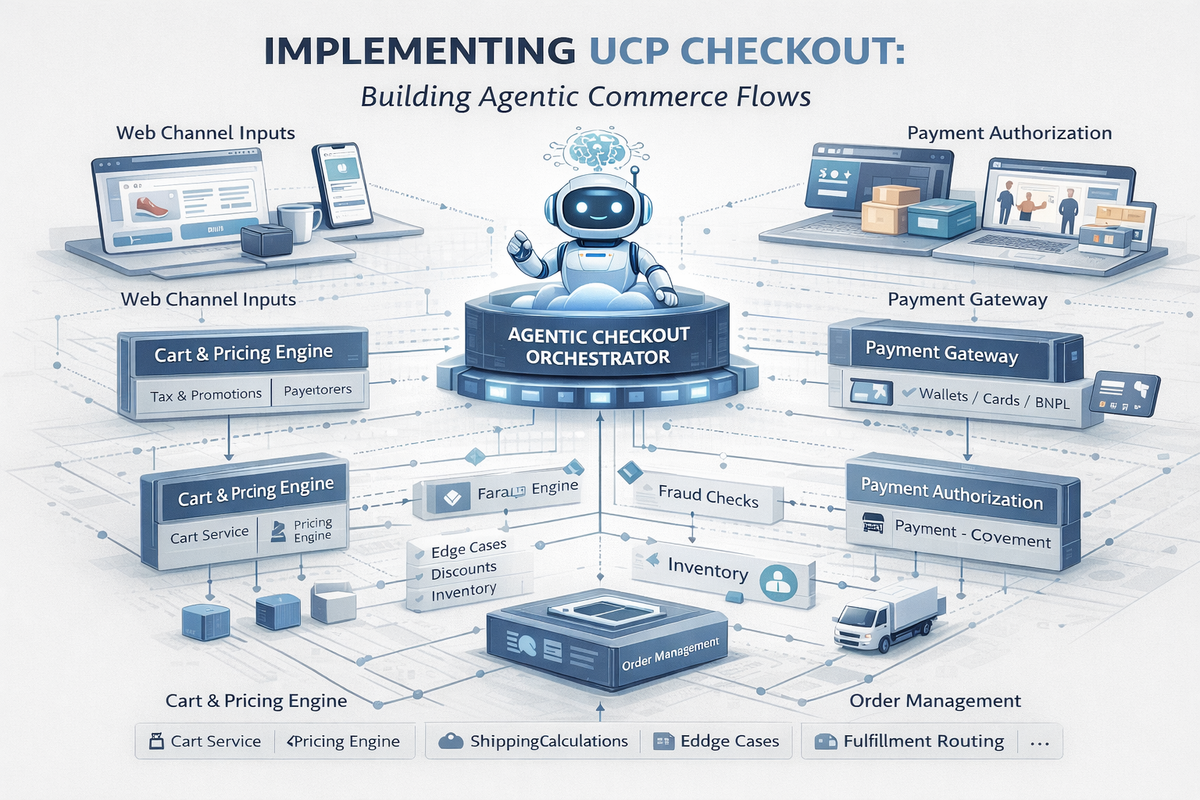
At its core, UCP Checkout is a REST API protocol that standardizes the conversation between AI agents, merchants, and payment processors. Instead of a human navigating a multi-page checkout flow, an agent makes a series of API calls that accomplish the same thing — in milliseconds.
The flow works like this. First, the AI agent queries the merchant's business profile — a machine-readable manifest published at /.well-known/ucp that declaratively states what commerce services the merchant supports: product discovery, checkout, order tracking, and which payment handlers they accept. Think of it as a merchant's commerce resume that any AI agent can read instantly.
Next, the agent creates a checkout session via a POST request, submitting the buyer's shipping address, contact details, and selected items. The merchant responds with a session ID, available shipping options, tax calculations, and payment requirements. The agent then obtains an encrypted payment credential from a credential provider like Google Pay — critically, raw card numbers never touch the AI platform — and submits it to complete the session. The merchant forwards the tokenized credential to their payment processor (Stripe, Adyen, etc.), and the transaction completes.
Three REST endpoints handle the entire lifecycle: POST /checkout to create a session, PATCH /checkout/{sessionId} to update it (change shipping method, apply a discount code, adjust quantities), and POST /checkout/{sessionId}/complete to finalize the purchase. All endpoints require HTTPS with minimum TLS 1.3, and authentication options include API keys, OAuth 2.0, or mutual TLS.
Two Integration Paths: Native vs. Embedded
UCP gives merchants two ways to integrate, depending on the complexity of their checkout logic.
Native checkout is the API-first approach. The merchant builds RESTful endpoints on their backend, and AI agents call them directly. This path offers maximum control and the fastest experience — the entire checkout happens through structured data exchange with no UI rendering involved. It's ideal for merchants with standard checkout flows: add items, set shipping, pay, confirm.
Embedded checkout is the web-based fallback. When checkout requires complex custom logic — loyalty program authentication, subscription configuration, bundle customization — the merchant's web-based checkout renders inside an iframe within the AI interface. Bidirectional messaging keeps the agent and the embedded UI in sync, and the customer still never leaves the AI conversation. The merchant maintains their branded checkout experience while gaining access to AI-driven traffic.
The smart move for most merchants is to implement native checkout for their standard flow and have embedded checkout as a graceful escalation path for edge cases.
The Security Architecture Behind Agent Payments
When an AI agent — not a human — is completing purchases, the security model has to be airtight. UCP addresses this at multiple levels.
Tokenization is non-negotiable. Payment credentials are managed exclusively by credential providers like Google Pay. The AI platform never sees raw card numbers, CVVs, or bank account details. Agents receive only encrypted or tokenized credentials, which they pass through to the merchant's payment handler. This architecture dramatically reduces PCI-DSS compliance scope for everyone in the chain.
Cryptographic proof of consent accompanies every transaction. Each authorization includes a cryptographic signature proving the user explicitly approved the purchase. This prevents unauthorized transactions and provides a clear audit trail — essential when the "buyer" is an AI agent acting on someone's behalf.
Fraud prevention layers remain intact. UCP supports 3D Secure verification, device fingerprinting passed alongside credentials, and session-level risk signals. Merchants retain full authority to reject high-risk transactions or request additional verification. The protocol doesn't bypass existing fraud infrastructure — it feeds into it with richer signals.
The result: a transparent accountability chain between agent, merchant, and payment processor, with the merchant always remaining the Merchant of Record and retaining full control of the customer relationship.
What Merchants Need to Build
Implementing UCP checkout isn't a moonshot — it's a structured integration project. Here's the practical path:
Step 1: Prepare your Merchant Center account. Ensure you have an active Google Merchant Center account with configured shipping settings, return policies, and a product feed with UCP-eligible inventory.
Step 2: Publish your business profile. Create a JSON manifest at /.well-known/ucp that declares your supported capabilities (checkout, discovery, order tracking), REST endpoint URLs, payment handler support, and authentication method.
Step 3: Implement the REST endpoints. Build three core endpoints — create session, update session, complete checkout — following the UCP specification. Handle standard checkout data: items, shipping options, tax calculation, discount application.
Step 4: Integrate payment handling. Declare your supported payment processors in the manifest. Implement the payment handler to receive tokenized credentials from credential providers and forward them to your processor (Stripe, Adyen, Square, etc.).
Step 5: Test and validate. Use Google's testing tools to validate your manifest, test both native and embedded flows, verify TLS 1.3 compliance, and handle edge cases — partial inventory, expired sessions, payment declines, refund flows.
For Shopify merchants, much of this is automatic. Shopify co-developed UCP, and their platform handles the protocol implementation — millions of merchants gain UCP checkout access through their existing Shopify infrastructure.
The Ecosystem Taking Shape
UCP isn't a solo Google project — it's an industry coalition. The co-developers include Shopify, Walmart, Target, Etsy, and Wayfair. The endorsing partners span payments (Stripe, Adyen, Visa, Mastercard, American Express), retail (Best Buy, Flipkart, Macy's, The Home Depot, Zalando), and technology platforms. Microsoft has also integrated UCP into Copilot, meaning Shopify merchants can sell through both Google's AI surfaces and Microsoft's.
The protocol sits alongside related standards: the Agent Payments Protocol (AP2) for secure agent-led payment flows, Model Context Protocol (MCP) as an alternative transport, and Agent2Agent (A2A) for inter-agent communication. Together, these form the infrastructure layer for agentic commerce — a market where 15% of retail transactions are already agent-mediated, with projections reaching 50% or more by late 2026.
Target has announced frictionless checkout within Google Gemini. Shopify merchants are already accessible through Google's AI Mode in Search. The protocol is live, and adoption is accelerating.
Challenges and What's Next
UCP checkout isn't without friction. Multi-jurisdiction compliance is complex — PCI-DSS, GDPR, PSD2 Strong Customer Authentication, and regional privacy laws all apply differently when an AI agent crosses borders on behalf of a buyer. Merchant readiness varies widely; while Shopify merchants get automatic access, enterprises with custom-built checkout flows face real integration work. And consumer trust in AI-mediated purchases is still developing — many shoppers remain uncomfortable with an agent entering payment details on their behalf, even with tokenization.
Looking ahead, the protocol's extensibility is its greatest strength. UCP is designed to support additional credential providers beyond Google Pay (PayPal is already announced), new transport mechanisms, and richer agent capabilities like subscription management, returns processing, and loyalty program interactions. The open-source specification means the community can contribute, and the governance model ensures no single company controls the standard.
The Takeaway
UCP Checkout isn't just a new payment API — it's the infrastructure layer for how commerce will work when AI agents become the primary shopping interface. Three REST endpoints. Tokenized payments. Cryptographic consent. A machine-readable merchant manifest. That's the foundation.
For merchants, the question isn't whether to support agentic checkout, but when. The 70% cart abandonment rate exists because traditional checkout was designed for humans navigating web forms. UCP checkout is designed for agents navigating APIs — and the agents are already here. Whether you're on Shopify (where UCP is built in), building on Commercetools (where MACH architecture makes integration natural), or running a custom stack, the implementation path is clear and the ecosystem is ready.
The brands that integrate first will capture the agentic traffic that's growing right now. The rest will be optimizing form fields while their competitors are optimizing API endpoints.
References
- Google Developers Blog: Under the Hood — Universal Commerce Protocol
- Shopify Engineering: Building the Universal Commerce Protocol
- Google: Universal Commerce Protocol Developer Guide
- UCP Specification: HTTP/REST Binding
- Google Blog: New Tech and Tools for Retailers in an Agentic Shopping Era
- Target: Frictionless Checkout in Google Gemini
- Shopify: The Agentic Commerce Platform
- Search Engine Land: Google Launches UCP for Agent-Led Shopping

Member discussion: