
How Claude Quietly Became the Developer's Best-Kept Secret
Ravi stared at his terminal at 2 AM on a Tuesday, three Red Bulls deep into a migration that was supposed to take two days. He was on day five. His team had 14,000 lines of legacy Java to refactor into microservices, a deadline that marketing had cheerfully moved up by two weeks, and a Slack channel full of engineers posting the same message: "Has anyone tried Claude Code for this?"
He hadn't. He was a GitHub Copilot loyalist. Had been since 2022. But desperation has a way of dissolving brand loyalty, so he typed claude into his terminal and hit enter. Forty minutes later, he pushed a commit that would have taken him two days by hand. He didn't tell anyone on the team. Not yet.
This is a story about how Anthropic isn't just building an AI model — they're running one of the most disciplined marketing strategies in tech, and it's rewriting what it means to be a developer in 2026.
The Strategy Nobody Saw Coming
While OpenAI was buying Super Bowl ads and Google was embedding Gemini into every product with a login screen, Anthropic did something counterintuitive: they went quiet. No celebrity endorsements. No viral stunts. Instead, they spent 2025 building infrastructure that developers couldn't ignore.
The numbers tell the story. Anthropic's annualized revenue hit $14 billion by early 2026 — a 14x jump from the $1 billion they were at in December 2024. Their API revenue of $3.1 billion quietly surpassed OpenAI's $2.9 billion. And here's the part that should make every developer pay attention: Claude Code alone generated $2.5 billion in annualized billings within nine months of launch.
That's not marketing. That's product-market fit so aggressive it doesn't need marketing.
The "Keep Thinking" Gambit
When Anthropic finally launched paid advertising in late 2025, they didn't target consumers. Their first brand campaign, "Keep Thinking," built with ad agency Mother, ran across live sports, Netflix, Hulu, and podcasts — but the messaging wasn't "try our chatbot." It was aimed squarely at developers, researchers, and business owners building real applications.
Then came the masterstroke. During Super Bowl LX in February 2026, while OpenAI was testing ads inside ChatGPT, Anthropic ran commercials promising Claude would remain ad-free. It was a surgical strike: position your competitor's revenue model as the user's problem, then offer yourself as the solution.
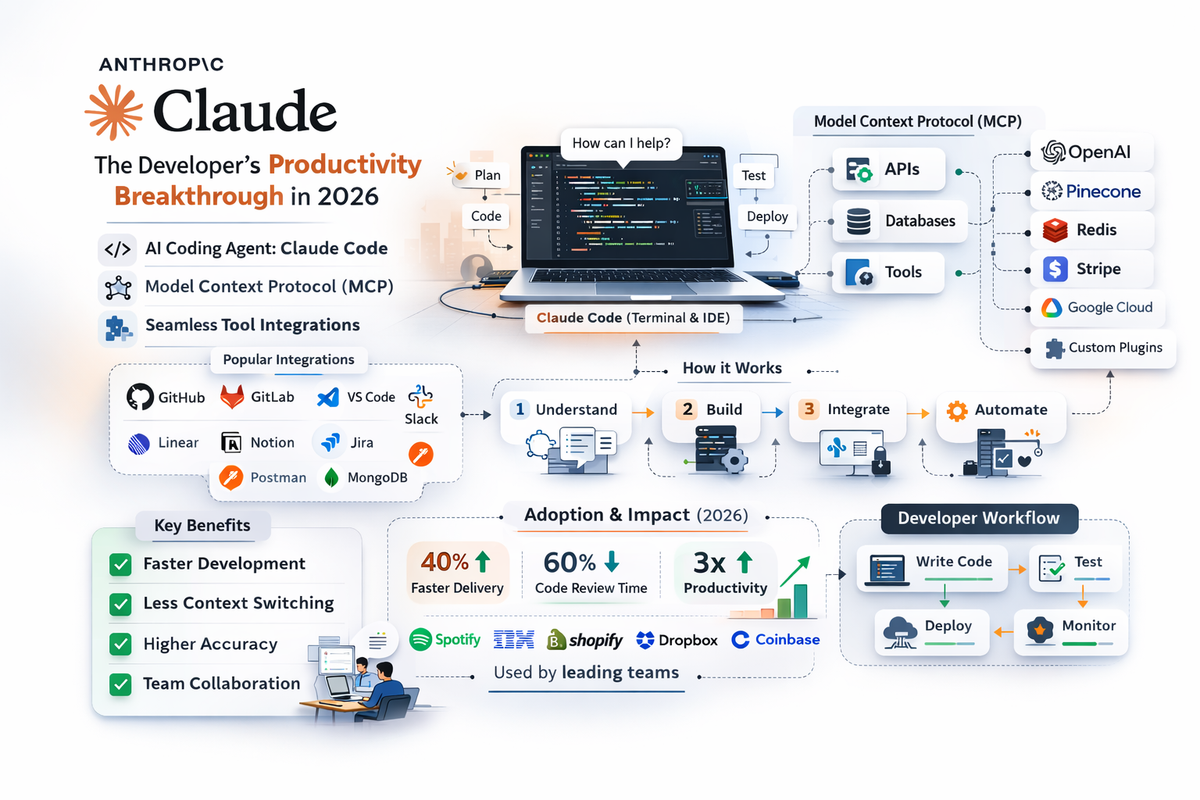
Back in Bangalore, Ravi watched the ad on YouTube during lunch. He'd been using Claude Code for three weeks by then — quietly, almost guiltily, the way you use a competitor's product when you've been publicly advocating for the other side. His refactoring velocity had tripled. He'd started using MCP (Model Context Protocol) to connect Claude directly to his team's Jira board, their Postgres database, their Slack channels. The AI wasn't just writing code anymore. It was reading the context his code lived inside.
The Three Pillars That Changed Everything
Anthropic's developer play rests on three pillars, and understanding them explains why engineers like Ravi are switching — often without telling their managers first.
| Pillar | What It Is | Why Developers Care |
|---|---|---|
| Claude Code | Terminal-native agentic coding tool. Reads repos, runs tests, submits PRs, handles git workflows through natural language. | Lives where developers already work — the terminal. No IDE plugin required. Reached top 3 AI coding tools within 9 months. |
| Model Context Protocol (MCP) | Open standard connecting Claude to external data: Slack, GitHub, databases, design docs, custom APIs. | Turns Claude from a code generator into a context-aware collaborator. Adopted by OpenAI, Google, Cursor, Figma, Replit. |
| Safety-First Enterprise Trust | Constitutional AI, audit logging, SCIM, compliance APIs, interpretability research. | Gets past enterprise security teams. Opens doors in regulated industries (finance, healthcare, defense) where ChatGPT can't. |
The genius of this stack is that each pillar sells the others. Claude Code gets developers hooked. MCP makes it indispensable by connecting to their actual workflow. Safety positioning gets the enterprise procurement team to approve the budget. By the time the CTO signs off, the engineering team has already been using it for months.
The Developer's Life, Before and After
Three months after his 2 AM revelation, Ravi's world looked different. His team had adopted Claude Code officially — after he finally confessed his secret productivity boost in a retro. The migration finished ahead of schedule. Not the moved-up schedule. The original schedule.
But the deeper change was structural. Tasks that used to require seniority — understanding a sprawling legacy codebase, designing API contracts, writing comprehensive test suites — were now accessible to mid-level engineers on his team. One junior developer used Claude Code with MCP connected to their architecture docs to propose a service decomposition that matched what Ravi would have designed himself. It took her an afternoon. It would have taken him a week.
The January 2026 developer survey from UC San Diego and Cornell found Claude Code among the three most widely adopted AI coding platforms — alongside GitHub Copilot and Cursor. Copilot still leads with 68% adoption among AI-tool-using developers, but Claude Code's growth trajectory is steeper. It's the terminal-native approach. Developers don't want another IDE extension. They want something that speaks their language — literally, through the command line.
The $380 Billion Bet on Developer Infrastructure
In February 2026, Anthropic closed a $30 billion Series G round at a $380 billion valuation — the second-largest venture deal in history. The money isn't going into consumer apps. It's going into compute.
Anthropic now has access to over 1 million Google TPUs, Amazon's custom Trainium chips at the $11 billion Rainier data center in Indiana, and a diversified GPU fleet. This multi-cloud strategy — AWS, Google Cloud, and NVIDIA — means Anthropic doesn't go down when one cloud does.
But the real play is pricing. Claude Opus 4.5, their most capable model, launched at $5/$25 per million tokens — a 67% cost reduction from the previous Opus. The new "effort" parameter lets developers dial computational spend: at medium effort, Opus 4.5 matches Sonnet's SWE-bench scores while using 76% fewer output tokens. Anthropic is making intelligence cheaper, not just better.
| Model | Input / Output (per 1M tokens) | Sweet Spot |
|---|---|---|
| Haiku 4.5 | $1 / $5 | High-volume classification, routing, quick code completions |
| Sonnet 4.5 | $3 / $15 | Complex agents, coding, most production workloads |
| Opus 4.5 | $5 / $25 | Hardest reasoning tasks, full codebase refactors, research |
The Partnership Moat
Anthropic's partnership strategy reads like a masterclass in enterprise distribution. Amazon invested $8 billion and made Claude a first-class citizen on AWS Bedrock. Google provided a million TPUs. Salesforce integrated Claude into Agentforce 360 — putting it inside the CRM that millions of businesses already use.
Each partnership serves a dual purpose: compute and distribution. Anthropic gets the infrastructure to train frontier models, and the partners get the best model on their platform. It's a flywheel: better models attract more developers, more developers attract more enterprise customers, more customers justify more compute investment.
What Ravi Learned at 2 AM
Six months later, Ravi gave a talk at a Bangalore developer meetup. The title was "The Tool I Was Embarrassed to Admit I Used." The room laughed. Half of them had the same story.
The punchline wasn't about Claude. It was about the industry. When an AI tool becomes so effective that developers feel guilty about using it — like they're cheating — the marketing strategy has already won. Anthropic didn't need to convince Ravi to try Claude. They needed to build something so good that someone in his Slack channel couldn't stop talking about it.
That's the strategy. Not billboards. Not influencer campaigns. Not SEO-optimized listicles. Just a product that spreads through engineering teams like a rumor — whispered in standups, shared in DMs, and eventually, reluctantly, announced in retros.
Ravi still codes at 2 AM sometimes. Old habits. But now when he hits a wall, he doesn't reach for a Red Bull. He types claude and hits enter. And the migration finishes on time.
References
- Anthropic closes $30B funding at $380B valuation — CNBC
- Introducing Claude Opus 4.5 — Anthropic
- Claude Code Overview — Anthropic Developer Docs
- Anthropic launches first brand campaign for Claude — Axios
- Anthropic's ad-free Claude vs OpenAI's ad-push — CNBC
- Anthropic and Salesforce Expand Strategic Partnership — Anthropic
- Google and Anthropic cloud deal worth tens of billions — CNBC
- Powering AI development with AWS Trainium — Anthropic
- Anthropic's Claude Code is having its "ChatGPT moment" — Uncover Alpha
- How AI safety is helping Anthropic win — Fortune

Member discussion: