
Day Three: How the Iran War Is Dismantling Global Fintech in Real Time
At 2:14 AM local time on Saturday, February 28, 2026, the first American cruise missiles struck Revolutionary Guard command centers across Iran. Within hours, Supreme Leader Ali Khamenei was dead, Iran's internet traffic had dropped to 4% of normal levels, and the financial architecture of the Middle East — a region that moves 31% of the world's seaborne crude — began to crack.
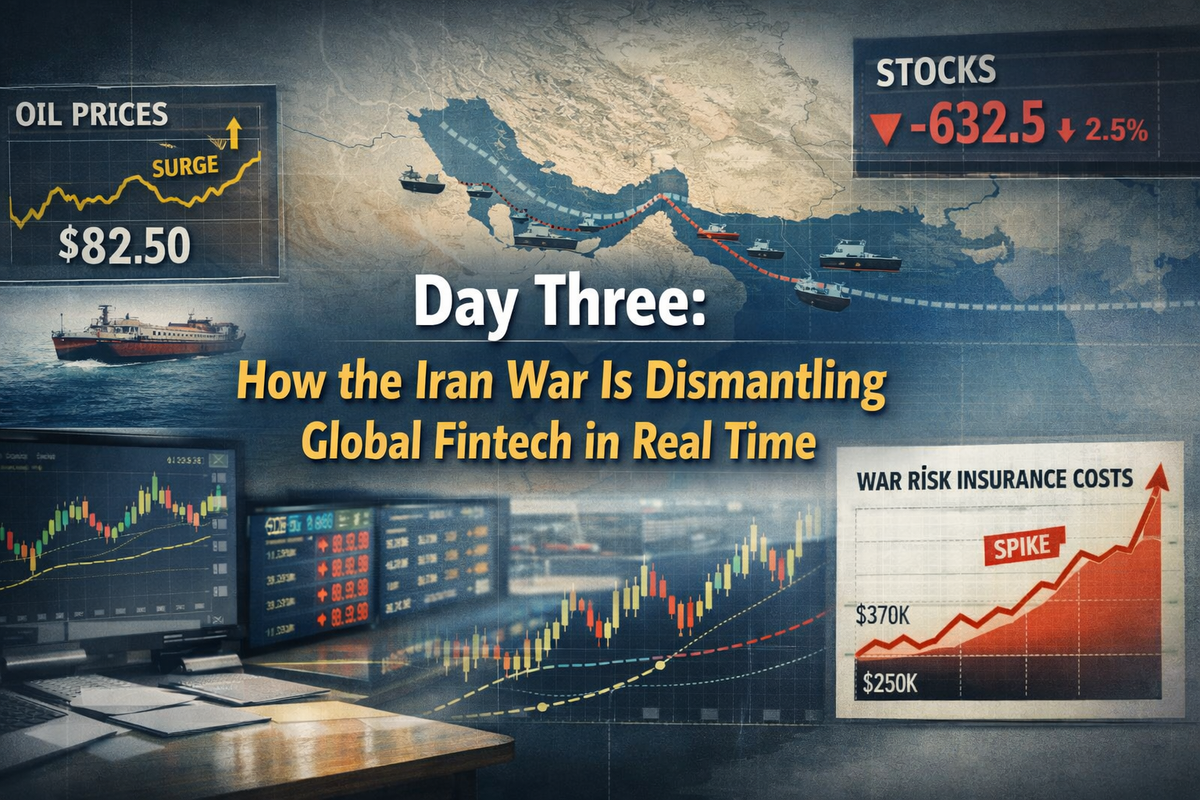
By Monday morning, March 2, Day Three of what the Pentagon calls Operation Roar of the Lion, the damage ledger reads like a fintech nightmare: UAE and Abu Dhabi stock exchanges shut down, Dubai International Airport on fire, the Strait of Hormuz functionally closed, Brent crude surging past $82, and war risk insurers issuing 48-hour cancellation notices on every vessel in the Persian Gulf.
This isn't a distant geopolitical event. This is a live stress test of every payment rail, insurance model, and trade finance instrument that touches the Middle East — and by extension, the world.
The Strait That Stopped the World
The Strait of Hormuz is a 21-mile chokepoint through which 20 million barrels of oil pass daily — roughly one-fifth of global consumption. On Saturday, Iran's Revolutionary Guard Corps issued warnings prohibiting vessel passage. At least three tankers were attacked. Tanker traffic dropped 70% within 36 hours, with over 150 ships anchoring outside the strait.
But here's what most people miss: Iran didn't need to physically blockade the strait. The insurance industry did it for them.
War risk insurers — firms like Skuld and NorthStandard — submitted 48 to 72-hour cancellation notices for ships operating in the Gulf and the Strait of Hormuz. Maritime insurance premiums are surging by 50%. For a $100 million vessel, that's an increase from $250,000 to $375,000 per voyage. Many underwriters aren't even offering quotes — they're simply refusing to cover the transit.
| Carrier | Action | Surcharge | Effective |
|---|---|---|---|
| Maersk | Suspended all Hormuz transits | N/A — no transit | March 1, 2026 |
| Hapag-Lloyd | War Risk Surcharge (WRS) | $1,500/TEU standard; $3,500 reefer | March 2, 2026 |
| CMA CGM | Emergency Conflict Surcharge (ECS) | $2,000/20-ft container | March 2, 2026 |
| War risk insurers | 48-72hr cancellation notices | 50% premium increase expected | Effective by March 5 |
The Gulf's Financial Fortress — Breached
For two decades, the Gulf states built themselves as the world's most stable financial hubs. Dubai became the tax-free haven for global elites. Abu Dhabi's sovereign wealth powered global markets. Qatar hosted the world's biggest LNG operation. The pitch was always the same: geopolitical storms happen around us, not to us.
That pitch died on Saturday night.
Iran's retaliatory strikes hit every member of the Gulf Cooperation Council — strikes in at least nine countries within 36 hours. Dubai's Jebel Ali Port caught fire after an aerial interception. The Fairmont hotel on Palm Jumeirah burned. The Burj Al Arab was damaged. Explosions rocked Qatar, UAE, and Kuwait as Iran targeted American military assets across the region.
The financial fallout was immediate. The UAE shut both the Abu Dhabi Securities Exchange and Dubai Financial Market — the first wartime closure in the exchanges' history. Dubai International Airport, the world's busiest for international passengers, sustained damage and grounded operations. 1,560 flights were canceled on Monday alone — 41% of all scheduled Middle East arrivals.
Markets in Free Fall — Then Recovery — Then Uncertainty
The financial markets told three stories in 72 hours.
Story one: panic. S&P 500 futures dropped 1.4% Sunday evening. The Dow plunged 543 points at Monday's open. Europe's Stoxx 600 fell 1.6%. Japan's Nikkei shed 1.35%. American Airlines dropped 5% on fuel cost fears. Brent crude surged 13% to $82.
Story two: calibration. By Monday afternoon, the S&P 500 and Nasdaq had clawed back into the green — up 0.1% and 0.5% respectively. Defense stocks rallied (Lockheed Martin, Northrop Grumman up 2-3%). Energy giants surged. The Dow recovered to just -30 points from its -600 trough.
Story three: the real fear. Oil at $80 is manageable. Oil at $100 — which ING and JP Morgan both flag as a realistic scenario if Hormuz stays closed — is qualitatively different. That adds 0.7 percentage points to global core goods inflation, forces central banks to reconsider rate cuts, and locks up working capital across every supply chain that touches the Gulf.
| Asset | Pre-War (Feb 27) | March 2 (Day 3) | Change |
|---|---|---|---|
| Brent Crude | ~$72/bbl | $78-82/bbl | +8-13% |
| Gold | ~$5,280/oz | $5,400+/oz | +2.3% |
| Bitcoin | ~$68,000 | $63,000-66,500 | -3% to -7% |
| 10Y Treasury Yield | ~4.15% | 3.96-4.06% | Flight to safety |
| VLCC Rate (ME→China) | ~W80 | ~W225 ($12M+) | Nearly tripled |
Crypto's Identity Crisis — Digital Gold or Digital Risk?
The crypto market's response to the Iran war exposed an uncomfortable truth that the industry has spent years trying to paper over.
When the first strikes hit, Bitcoin briefly spiked to $68,196 on the news of Khamenei's death — a reflexive "chaos trade." But as Iran's retaliation escalated — missiles hitting Gulf states, Saudi oil refineries attacked, Hormuz closing — Bitcoin dumped to $63,000. Total crypto futures open interest dropped 2% to $93.78 billion. Over $300 million in long positions were liquidated.
Meanwhile, gold surged past $5,400. JP Morgan raised its year-end target to $6,300. And on crypto exchanges themselves, traders made a telling choice: they bought tokenized gold (Paxos Gold, Tether Gold) — not Bitcoin. People with access to both "digital gold" and actual gold chose gold.
Bitcoin is down roughly 30% from its late-2025 peaks. The "digital gold" narrative didn't survive contact with a real war. When missiles are flying, crypto trades like a tech stock — it gets sold alongside equities, not bought alongside safe havens.
Iran's Digital Blackout — and the Fintech Sanctions Playbook
The military campaign against Iran wasn't just kinetic. It was digital. Iran's internet traffic dropped to 4% of normal within hours of the first strikes. Government digital services failed. Official news sites went offline. Local fintech apps — the payment platforms that millions of Iranians depend on daily — stopped functioning.
Simultaneously, the US Treasury expanded sanctions beyond traditional banks to target Iran's fintech infrastructure directly. One key target: RUNC Exchange System Company, which operates an alternative interbank messaging network enabling transactions with sanctioned partners like China's Bank of Kunlun — effectively a shadow SWIFT that helps Iran bypass the Western financial system.
This represents a strategic evolution. Previous sanctions targeted banks and oil companies. Now they target the technology layer — the alternative payment platforms, shadow banking channels, and local fintech firms that have become Iran's financial resilience backbone. It's an acknowledgment that in 2026, cutting off a country's fintech is as strategically important as cutting off its oil.
The implications for the broader GCC financial ecosystem are significant. Russia's SPFS (550+ institutions across 24 countries) and China's CIPS ($17 trillion in transactions in 2023) have been growing as SWIFT alternatives. Every round of Western financial weaponization accelerates adoption of these parallel systems — fragmenting the global financial architecture into competing blocs.
The Houthis Are Coming Back
As if the Hormuz crisis wasn't enough, the Houthis announced on February 28 that they would resume missile and drone attacks on US and Israeli-flagged ships in the Red Sea — ending a three-and-a-half-month pause that had brought relative calm since November 2025.
Two senior Houthi officials told the AP that renewed attacks could begin "imminently" and would target the same shipping routes struck during their 2024-2025 campaign, when 150 attacks reduced Red Sea container shipping by 90%.
This means the world's two critical maritime chokepoints — the Strait of Hormuz and the Bab el-Mandeb/Red Sea corridor — could be simultaneously disrupted for the first time in modern history. Together, they handle roughly 40% of global seaborne trade. The UN Security Council extended its Houthi monitoring through July 2026, but monitoring is not deterrence.
• Insurance-as-infrastructure: War risk premiums are now the de facto traffic controller for global trade. Parametric insurance, real-time risk pricing, and conflict-aware underwriting are no longer innovation — they're survival.
• Gulf fintech exodus: Every startup that chose Dubai or Abu Dhabi as a launchpad is recalculating. Singapore, London, and Riyadh (further from Iranian missile range) will see inbound interest surge.
• SWIFT fragmentation accelerates: Russia's SPFS and China's CIPS will gain adoption as GCC countries hedge against Western financial system dependence.
• Stablecoin regulation fast-tracks: Governments will move faster on stablecoin frameworks — both for humanitarian use and to close sanctions evasion loopholes.
• Oil-driven inflation reshapes rate expectations: If Brent stays above $80, the Fed's rate-cut timeline collapses, repricing every growth-stage fintech valuation.
What Comes Next
President Trump says the operation will last "four to five weeks." That's optimistic by any historical standard. But even if the military campaign ends quickly, the financial aftershocks won't.
The Gulf's stability premium — the implicit safety guarantee that attracted trillions in capital — has been fundamentally questioned. Missiles hitting Palm Jumeirah hotels and tankers burning in the Gulf of Oman aren't risks that can be priced away with a few basis points.
The Strait of Hormuz crisis has demonstrated that insurance, not navies, controls modern trade flows. When underwriters refuse to quote, commerce stops — regardless of whether the waterway is technically open. This insight will reshape how trade finance, supply chain finance, and marine insurance are built for the next decade.
And the war has revealed the deepening fragmentation of global financial infrastructure. As Western sanctions target Iran's fintech layer, as Russia and China build parallel payment networks, and as stablecoins become humanitarian lifelines in conflict zones, the vision of a unified global financial system is fracturing in real time.
Day Three is just beginning. The missiles will eventually stop. The financial restructuring won't.
References
- US, Israel attack Iran: Khamenei, top security officials killed — Al Jazeera
- US stocks recover, gold rises and oil surges as war with Iran spreads — CNN
- Strait of Hormuz escalation rattles global shipping — The National
- Marine insurers cancel war risk cover as Iran conflict escalates — Insurance Journal
- Iran attacks Dubai: the tax-free haven could see catastrophic fallout — Fortune
- Bitcoin tops $68,000 after Iran confirms Khamenei death — CoinDesk
- Treasury targets financial network supporting Iran's military — US Treasury
- Houthi rebels to resume Red Sea shipping attacks — AP/WTOP
- Markets brace for impact after US strikes Iran — CNBC
- Iran's retaliatory strikes challenge image of Gulf stability — TIME
- Sanctions & SWIFT alternatives: what Iran's isolation means for GCC — GCC Business Watch

Member discussion: